
A step back in time…
The Octagon House Museum, located in historic Watertown, Wisconsin was built by:
Pioneer settler John Richards and completed in 1854. The unique 8-sided design for this grand residence was inspired by New York architect Orson Fowler, who promoted the healthy living aspects of octagonal dwellings in the 1850s.
The solid brick, five-story mansion was built with early forms of central heating, running water, and ventilating systems. A magnificent four-story central cantilevered spiral staircase rises four stories from the first floor to the cupola or “tower room” where one can enjoy sweeping vistas of the city and surrounding countryside.
The Octagon House was one of the largest homes built prior to the Civil War in Wisconsin. Its only occupants have been members of the Richards family. Following the passing of Anna Richards Thomas in 1936, the mansion was donated in 1938 to the fledgling Watertown Historical Society whose dedicated members have maintained the Octagon House as a public museum ever since.
The museum grounds are home to the First Kindergarten in America founded in Watertown by Margarethe Meyer Schurz, a restored pioneer barn, a delightful 1936 model of the Octagon House and a tour center with gift shop.
I have personally toured this amazing old home 3 times! I love the history of it as well as the unique shape of the home. I was even interested in leading tours but unfortunately my finances wouldn’t allow me to do so.
Welcome to The Octagon House! Home of John and Eliza Richards. Built by John approximately 1854. John Richards came here in 1837 with a traveling companion John Chadwick; he traveled here via the Great Lakes. Then walked up to Watertown from Chicago. After his arrival, he purchased some land east of the Rock River and built a log cabin. In 1841, he headed back East and asked his sweetheart Eliza to marry him. He promised to build her the finest house in the mid-west if she would marry him and come back to Watertown with him. She agreed and in July 1841 John and his bride ran off to New York and were married at the Dutch Reformed Church there. They then set out for their new home, still, at this time a log cabin and a farm.
John and Eliza lived in their log cabin for 13 years until their fine home was finished. They had 8 children and 7 of their 8 children were born in the log cabin. They lived as pioneers in this log cabin on their farm. In the early 1840’s he and a few others built a dam across the Rock River below the hill. Named the Rough and Ready Dam, on the dam he founded a grist mill, a saw mill, and a linseed oil mill. He quickly became one of the richest men in the city of Watertown. John and Eliza purchased 105 acres of land on June 1, 1846 for $1000.00. The Richards’ land extended to the street beyond Washington Park to the west, Concord Avenue to the East, Luther Prep School to the North and the end of Charles Street to the South. The house was finished in approximately 1854, at a cost of about $10,000. This figure, which is based on 1854 money today it would be 2.5 million. This includes the land and the labor costs. The home stood in the middle of a large and thriving farm.
The octagon home was a popular building type which lasted from the mid 1840’s to the beginning of the Civil War. This is one of three that stood in Watertown at one time and one of 25 still in existence in Wisconsin. The building fad was popularized by Orson Fowler, a well know phrenologist and free thinker. It was felt that this shape, which allows for more natural sun-light and air passage was a very healthy sort of home in which to live, and offers more square footage.
The structure built in the shape of a perfect octagon, measures 50’ by 50’ and rests on a 17” foundation which is entirely beneath the surface. The outside wallis 13” thick and contains three Wythe (layers) of brick. The partition walls, with the exception of those around the stairwell, have two layers of brick and are 8” thick. The pressed, cream-colored bricks for the exterior or veneer are said to have been hauled from Milwaukee by ox & cart over the Watertown plank road. It took four trips to bring in all the brick he needed, and brick was rather inexpensive he could get about 1000 bricks for 4 cents. The rest of the brick is Watertown brick manufactured here from 1847 to 1933.
The Foyer Entry into the house is made through a Benjamin door. The door takes its name from the architect Asher Benjamin (1773 – 1845), who designed it in the 19th century. This door has narrow sidelights and a transom window. The house has a total of 57 rooms which includes halls and closets, and once had 63 doors. Some of the doors were removed after the house became a museum, there are 4 triangular shaped rooms and 4 square shaped rooms on each level. The foyer is one of the triangle shaped rooms.

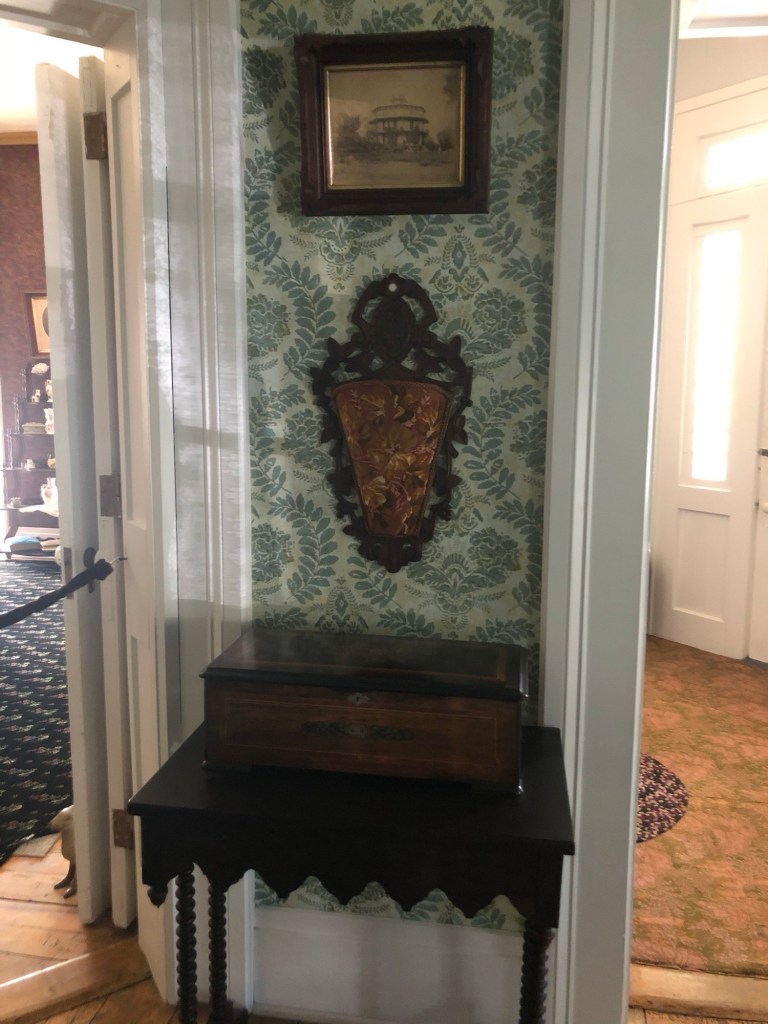
1. The wallpaper in this room came from an old house in Maine, the historical society purchased it from auction in New York City and it was shipped here and came wrapped in cheesecloth to preserve the moisture. It is an imported French cathedral style paper and well over 100 years old. It was put it up in strips because we had so little of it.
2. The Richards Family Coat of Arms: The Richards family was of English descent and a Coat of Arms is something you would see in an English family home.
3. The Picture of the home to the left of the parlor door, depicts an image of the home in the early years from the south.
4. Calling cards: Victorian Era 1850-1900, social cards similar to business cards one would “call” on the lady of the house and leave her card. if she had a maid – she may see if the lady of the house was at home and could receive her guest.
The Music Room A few general remarks regarding the music room: This was a very formal room, used only for entertainment or when the children would have taken music lessons. From family sources, we are led to understand that the Richards girls played piano, perhaps taking lessons from one of several piano teachers here in the 1800’s.
The curtains here are made of Brussels lace and were made in the lace factory in New Glarus, WI. The red felt draperies at the top once hung in the home of Theodore Prentice, the first Mayor of Watertown. His home is on Clyman Street. Currently a private residence. The Mirror is a “pier mirror” a pier mirror is a mirror which is placed on a pier, i.e., a wall between two windows supporting an upper structure. It is therefore generally of a long and tall shape to fit the space. This was a common decorating feature in the reception rooms of classical 18th-century houses. Spanning the height of the room the ceiling height on the floor is 10’ 10”. This mirror is made of black walnut and all hand carved. It is all original and has never been re-silvered, it is said to have gold dust mixed into the silver and that is why it has never needed re-silvering. Looking closing at the carvings you see flowers and leaves, standing back the top of the mirror looks like the head of a lion.
The center table is also made ofblack walnut and hand carved and has a removable marble top. We call this the four seasons table for the four faces on it, the man with the mustache represents old man winter, the two ladies’ summer, and spring, and the other man autumn. This table was made in Milwaukee WI, and dates to the 1860’s. This table, along with the mirror, belonged to John W. Cole. John and Luther Cole, brothers, were business partners of John Richards in his mills and the table and mirror were stored in a barn until the 1940’s when they were brought here to the museum. This table is similar to the one on which Abraham Lincoln signed the Emancipation Proclamation on September 22, 1862.
The oil portrait is of Rose Rogan Crangle. She was the daughter of Patrick Rogan a one-time post master here as well as a delegate to the state constitution meetings of 1846 and 1848. This painting is a good example of linear perspective, whereever you are in the room it looks as if the eyes are following you. This is done by having the person look away from you and focusing on a different focal point while being painted instead of looking directly at you.
The Richards family is the only family that has ever lived in the house. Most of the house is still in its original state, it was never converted or modernized. No gas, electricity or plumbing put into the house by the family. All of the light fixtures you see are the original oil burning lamps, the one here in the music room is spring loaded and could be pulled down. The Historical Society added a small amount of electricity after the house became a museum and we have also added climate control for the purpose of preserving the house and its contents.
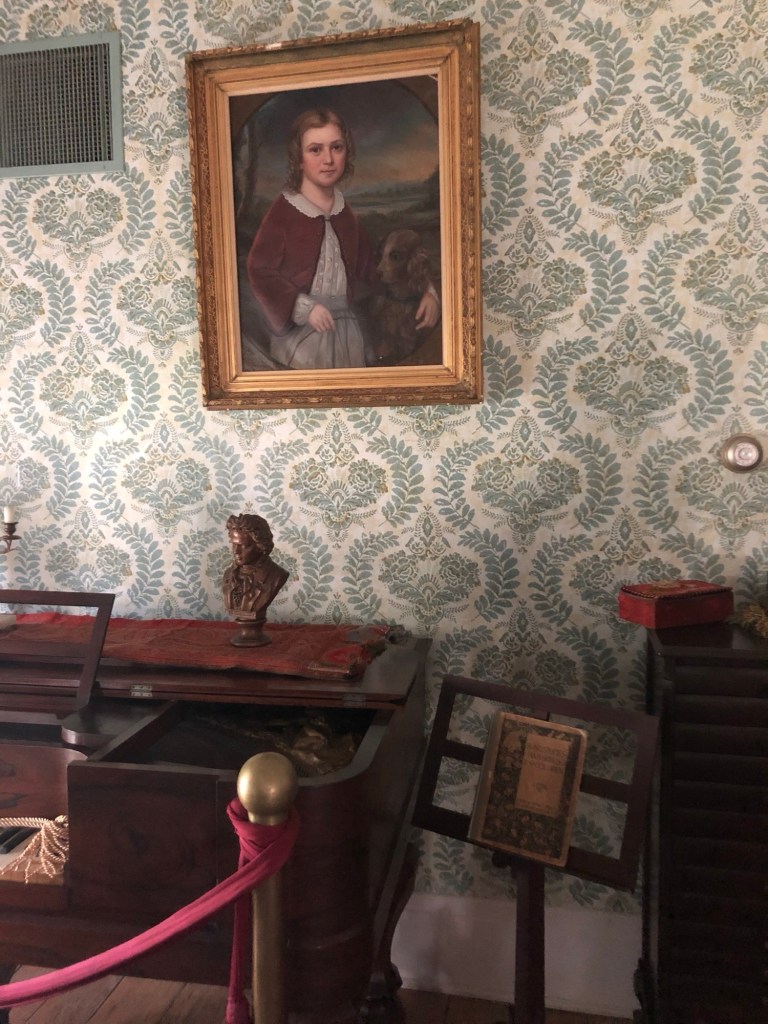
The painting of the little boy and his dog above the piano is something of a mystery. It is widely believed that this is a picture of Moses Richards, the first son born to John and Eliza Richards. What is known is that when the house came under the ownership of the historical society in 1938, this painting was found in one of the closets. The painting was done in two stages: first, the artist would come to town with a wagon load of pre-painted backgrounds and bodies. You selected the one you like best and the painter would then paint the head on.
The picture of the house (on the south wall between the parlor and foyer) is one with the original porches, those porches lasted until about 1920, when they needed to be removed because they were no longer safe. So, the house stood without the porches from 1920 until 1982 when the Historical society received a donation stating that the money was to be used to restore the porches to the home and those are the porches that you see today. The rug in this room is a Wilton Carpet, given to the historical society by Howard Donner, a relative of the Richards family. The rug dates to the 1890’s. The wall paper here was put up in 1974 and was designed for the Victorian room in the Ford Museum in Dearborn, Michigan.
The Parlor:
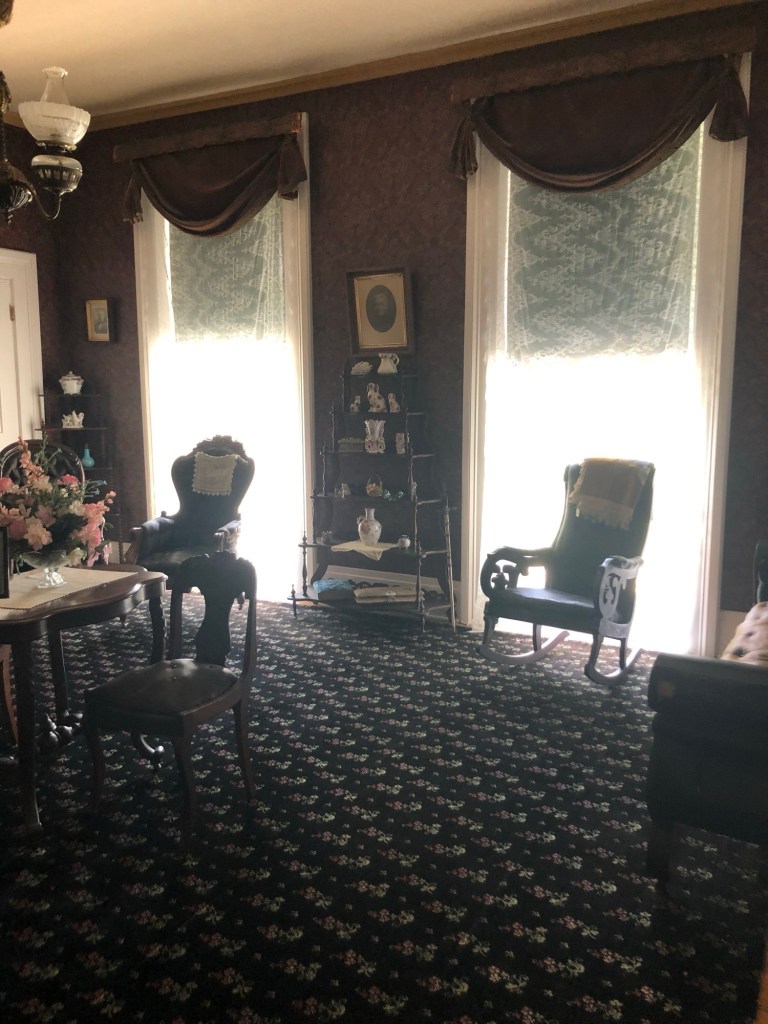
A very formal room indeed, only open for special occasions, would have been used for a wedding, Sunday company, Christmas, or a funeral. Hence the term funeral parlor.
This is the only room in the house that has a wallpapered ceiling that will give you more insight into the formality of this room and how special a parlor was. Virtually all of the furniture here is original to the family. We are fortunate to possess about 60% of the original furnishings. When the family gifted the house to the Historical Society in 1938 it was requested that the house be used at a museum and open to the public and that the Parlor contain the family furnishings. It has been that way ever since. The black horse hair chaise and sofa are original and typical of the time period. The tea table in the center of the room is original. Eliza having come from a family of Scottish origin one would have expected that tea time was a daily occurrence, so we have tea set up here for Eliza.
John Richards Died in 1874 at the age of 68. He had a stroke while on a business trip to Fond-du-lac. Charles was 14 at the time. Eliza took over the estate and ran the home and farm. With the help of her grandson William Thomas, she sold the land off around the house and was able to have an income and keep the house. Eliza died in 1902 at the age of 86. Anna and William continued to live in the house until their deaths. The house became a museum in 1938 and has been that way ever since.
The fireplace is the only one in the home. The home has a central furnace that heated the entire home that we will see when we go in the basement. The fireplace is made of Vermont marble and was a gift from Eliza’s parents.
The Dining Room:
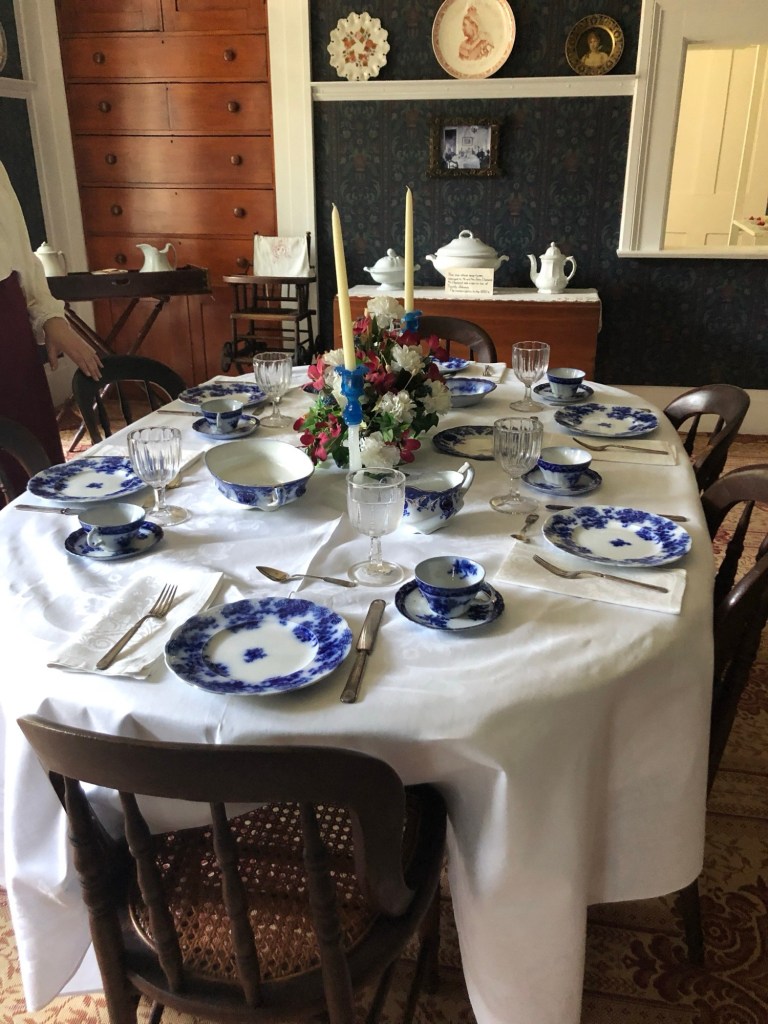
The dining room was wallpapered in the early 1990s. You may notice how bright this room is, Mrs. Richards chose not to have heavy draperies in this room, this room faces mostly north and she felt cotton pulls were sufficient in shading the light. Taking a closer look at the windows you can see that some of the panes of glass are still the original glass, you may also notice hinges on these windows because they are actually French doors. With the exception of the kitchen, third floor, buttery and family parlor all of the windows in the house open this way so that you can walk out onto the porches, also a great way to let in light and ventilation. John also did this because he had discovered a property tax in the area which taxed you by the number of windows you had in your home. (He said,“I didn’t put in windows, I put in doors.”)
The small room on the left is a bedroom, most l ikely used by John and Eliza’s son William Richards, they called him Willie. Willie was injured in a baseball game as a youth and left semi-paralyzed from the waist down. They made this his bedroom so he would not have to climb up and down the stairs. This room gives you a perfect idea of what it was like to be a child here and to have a bedroom like this. He lived to be 30 and there is picture of him on the wall above the bed.
The table and chairs are original and have never left this room since first being brought into the house in the late 1850’s. The chairs have been re-caned but the rest is all original. It is a unique table that has leaves that make it longer, but it is also a drop leaf table. The story goes that John Richards was an eccentric man who dressed in old clothes, wore a rope for a belt, stuffed straw in his boots when it was cold and often wore a floppy old hat. When he walked in to very upscale Milwaukee furniture store to purchase this table set dressed like this, he was very nearly thrown out by the clerks who thought he was a hobo. When his name was mentioned to the store owner, however, Richards was given carte blanche. “Why he’s the richest man in Watertown,” the owner of the store was supposed to have said, “Let him have whatever he wants. He’s good for it.” The built-in china and linen cabinet is original and made of cherry wood. The drop leaf table on the right of the room is made of choke cherry wood and was made by John Richards. The Ironstone soup tureens on top belonged to John and Jane Chadwick, daughter and son-in-law of Timothy Johnson; founder of Watertown.
Through a little window on the right one can see into the butler’s pantry, a room where china and some food stuffs were kept. Also, to be found here is the dumb waiter, which is a rope driven elevator that brought the food up from the kitchen below us. This made it easier to transport food from the kitchen rather than carrying it up the stairs.
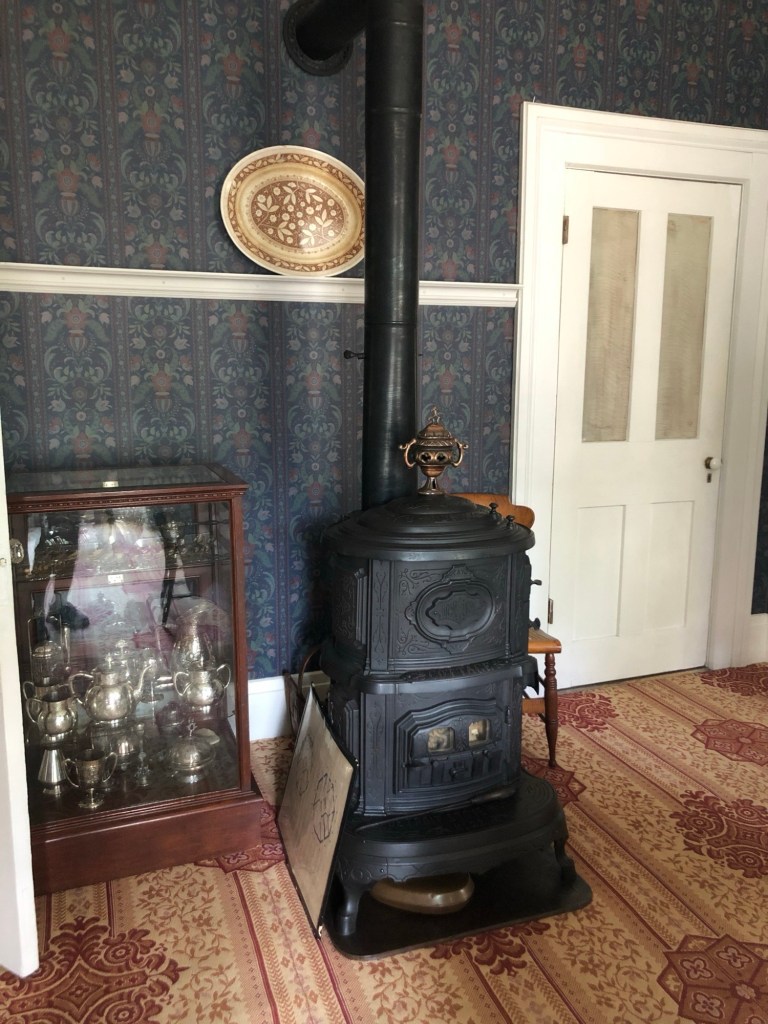
Behind the door is a case containing the original Richards family silver. Some pieces have the Forbes’ initials. The silver butter dish is dated 1790, and is known to have belonged to Eliza’s mother. There is a service bell with shells on the shelf that belonged to Mrs. Richards. An interesting story, fact or fancy, has been passed along: During the Civil War, an escaping slave stopped here on his way to Canada. Evidently Mrs. Richards was gracious to him and perhaps provided a night’s lodging. On his way back after the war, he stopped to see her and brought this bell from Canada as a gift of appreciation. (There is no knowledge of an underground railway for slaves through Watertown.)
The stove is an original Richards piece and was moved here from the family parlor. Alongside the stove are the house plans.
Family Parlor/The Living Room:
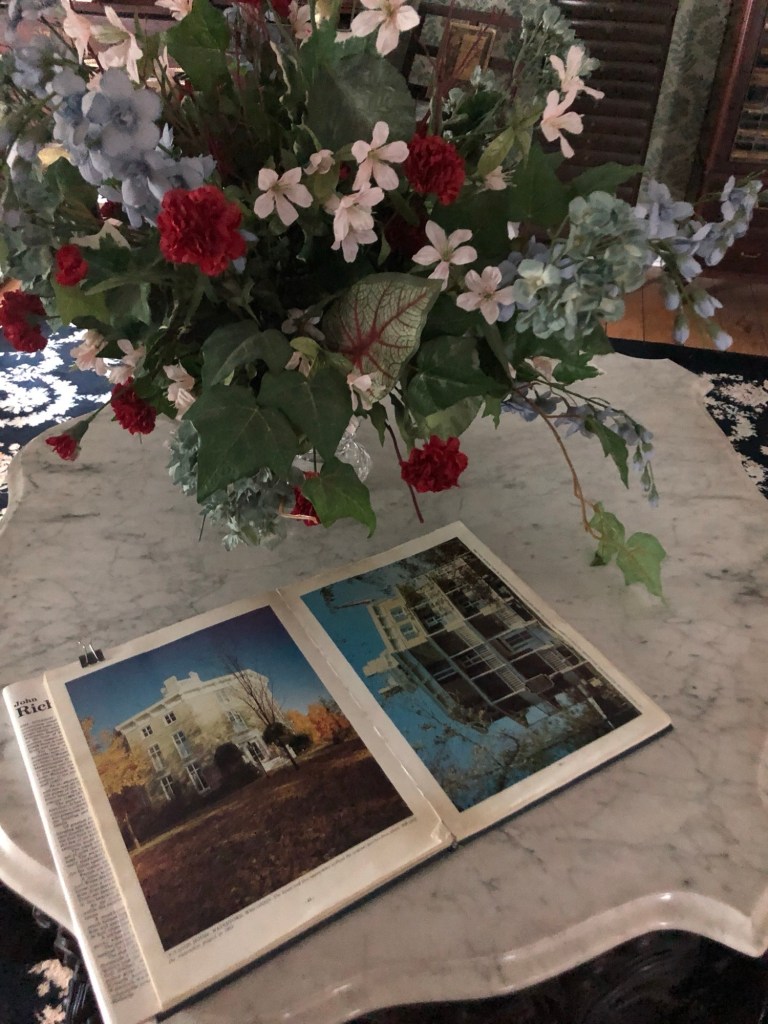

This room was the one room on this floor which that family used regularly.
There has been some debate about whether or not Eliza Richards had servants. In the 1860 census 1 servant was found to be listed as living here. Eliza may have also had day servants that did not live in the house. John had the mills below the hill and the farm. He offered room and board to mill hands and farm labors. Room and board would be around $1.00 a week. Boarding house around $5 per week. Mill workers make $25- $28 a month, farmers $30. Mill workers worked 6 days, 10 hours per day. Farm workers 7 days a week sun-up to sundown. They are saving to buy their own land and build their own cabin. But it was not proper for any hired help to use the main staircase so they had their own staircase. The servant’s staircase is here. Opening the door for your guests you can show them how steep the staircase is and how narrow to save space. This stair case goes up to the second floor to a small room where you can walk around to a second flight of stairs that takes you to the living quarters on the top floor.
The Spiral Staircase:

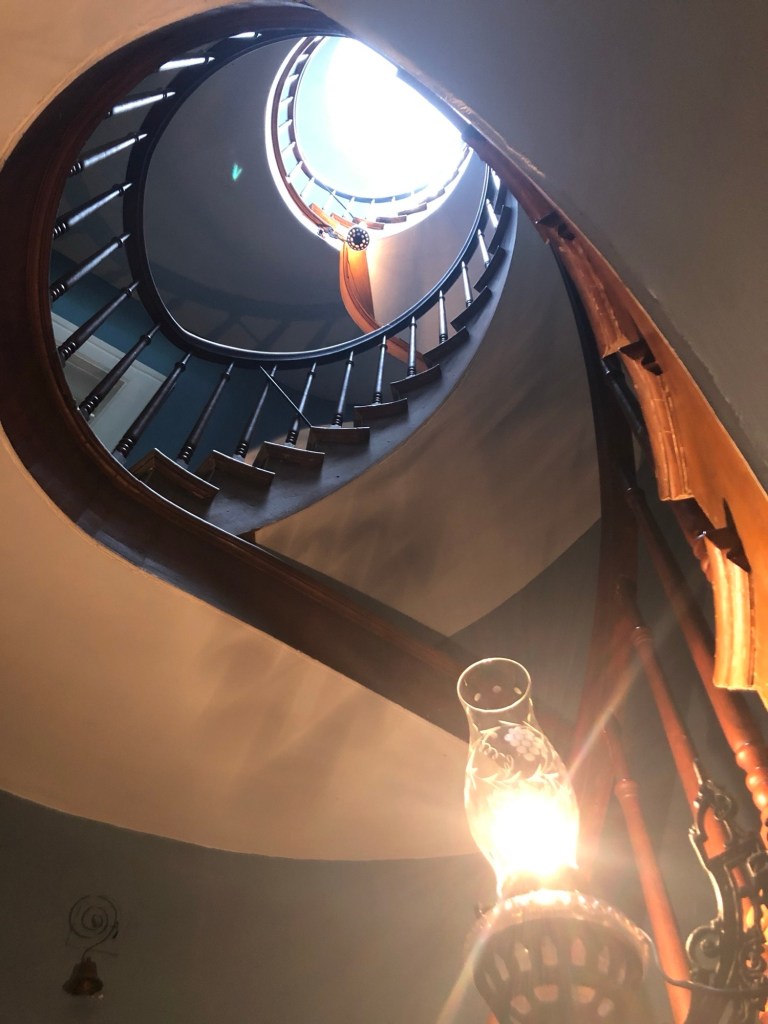

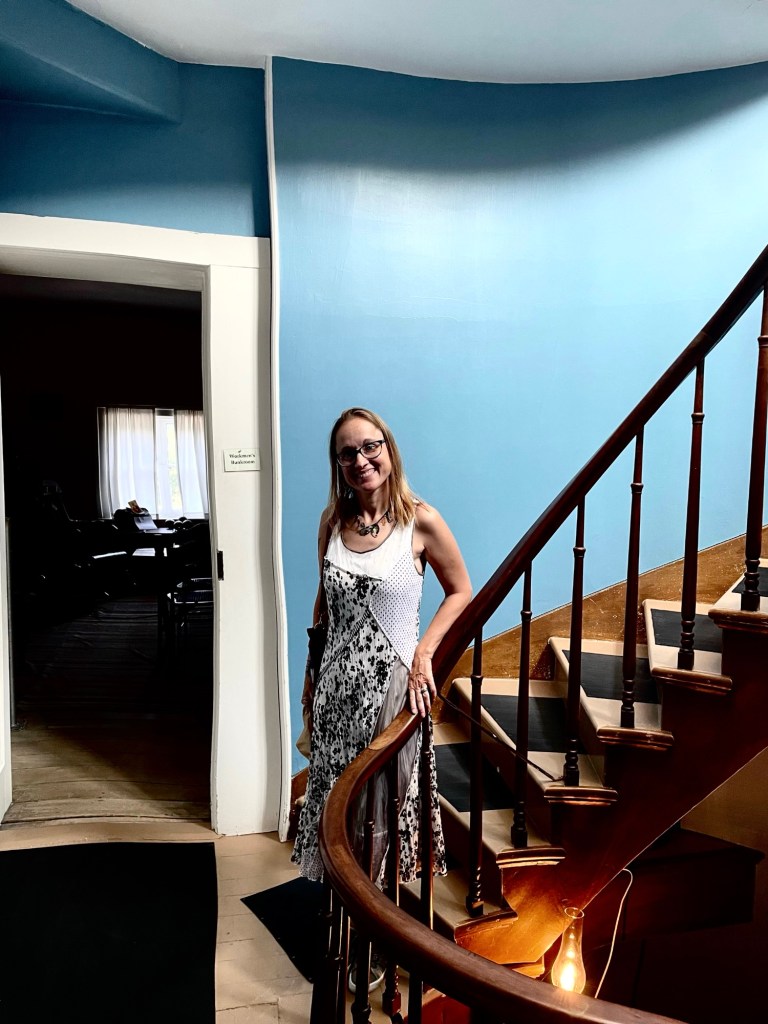
We are now in the center of the house. Looking all the way to the top of the cupola you are looking 40 feet up. The box at the top used to open, operated by a pulley system that could be opened on a warm day to help ventilate the house. We now have a ventilation fan up there. The cupola was used mainly to light the stairwell because as you can see there are no window here. Also used for roof access.
These walls consist of three solid brick layers, one chimney in each wall for a total of 4 each with a flue and hot air duct leading to a register in each of the twelve major rooms. The stairway has been called a masterpiece of stair-makers art. It is one of a few of its kind in the country. Unsupported on one side, it is so rigidly anchored at the floor levels it does not creek or groan when you climb it. The treads are very evenly spaced apart you feel little discomfort when climbing it. There are 54 treads on the main circular staircase and 14 that go down to the basement. The treads are made of bass wood and hand turned railings are made of cherry wood all which came from the farm. They have never been repaired and are in original condition the only thing we have done is to support the hand railing.
I would include more pf the house but I feel that you should immerse yourself in the experience of going there yourself to enjoy the sight of this gorgeous house and history!
I hope that you have enjoyed what I have shared with you and take the trip to give your eyes and mind a journey you won’t forget!
I’ll include some photos of the schoolhouse located on the property as well.
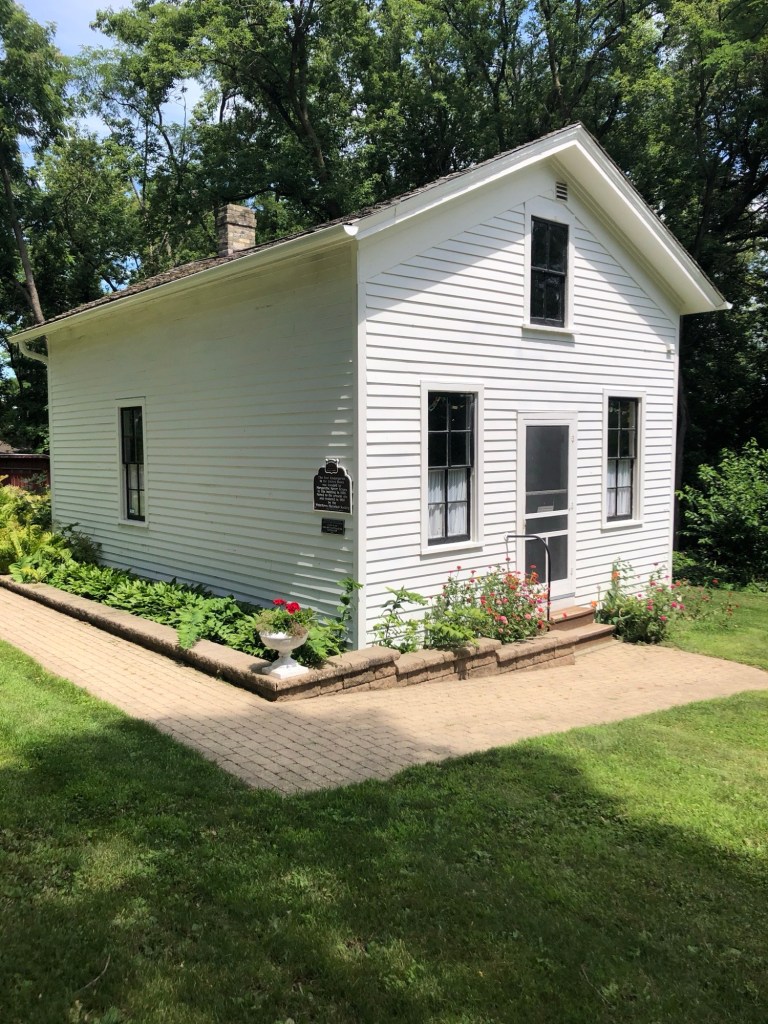
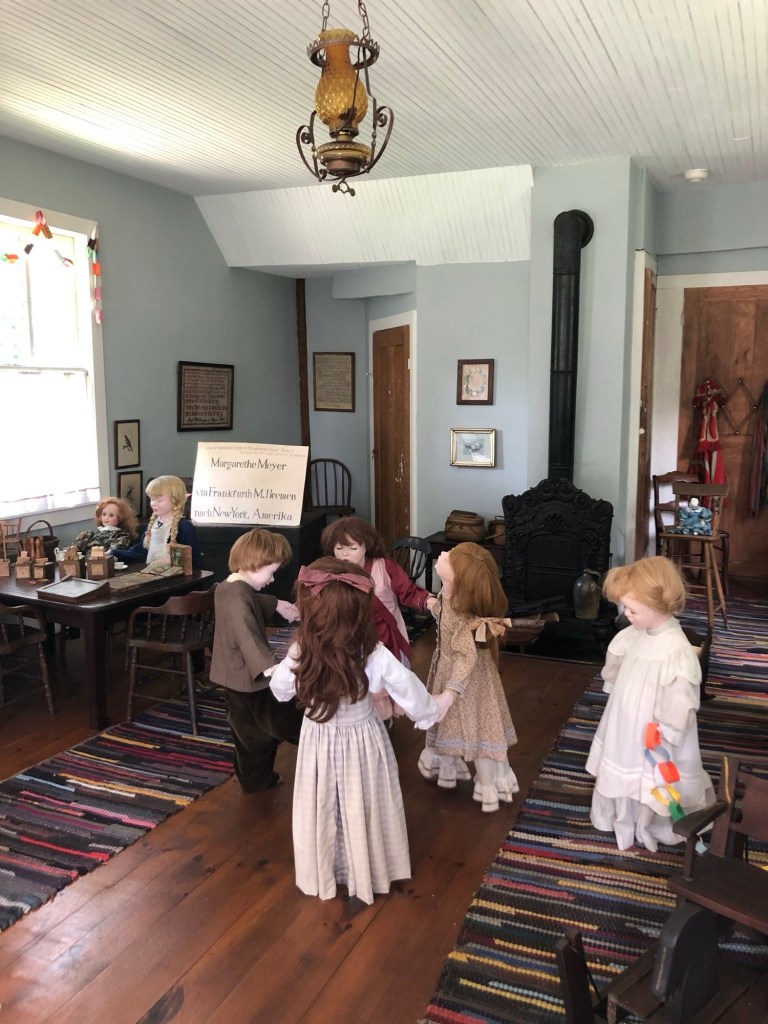
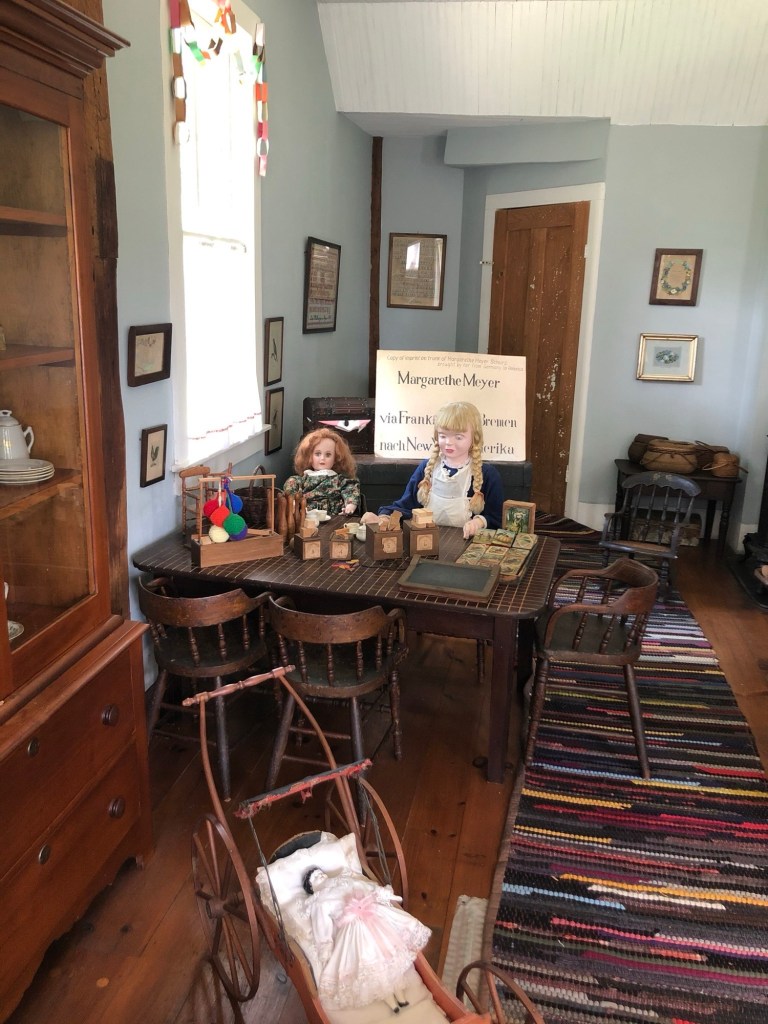
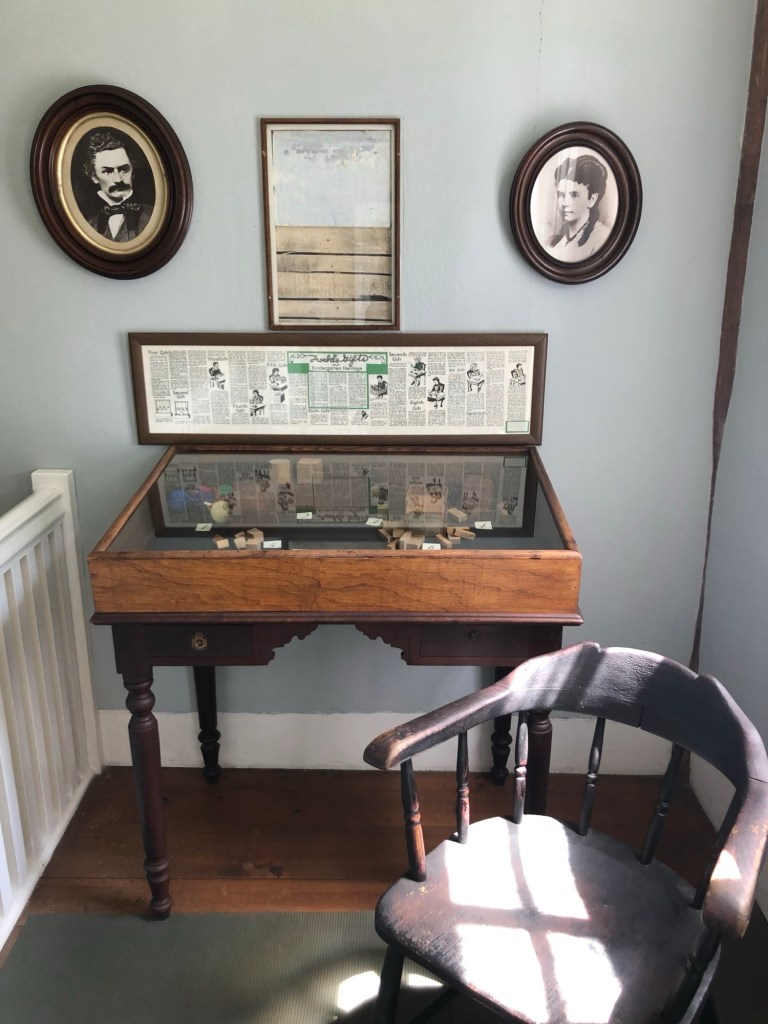
There is a bountiful amount of rooms and interesting items from the past to look at and learn of the history! I reccomend taking the time to visit and enjoy it!
I love it and plan to go back again this summer!
 Live life to the fullest! Explore your world!
I learnt something new today.
LikeLiked by 3 people
Nice! I love sharing with others locations that I fond intriging!
LikeLiked by 2 people